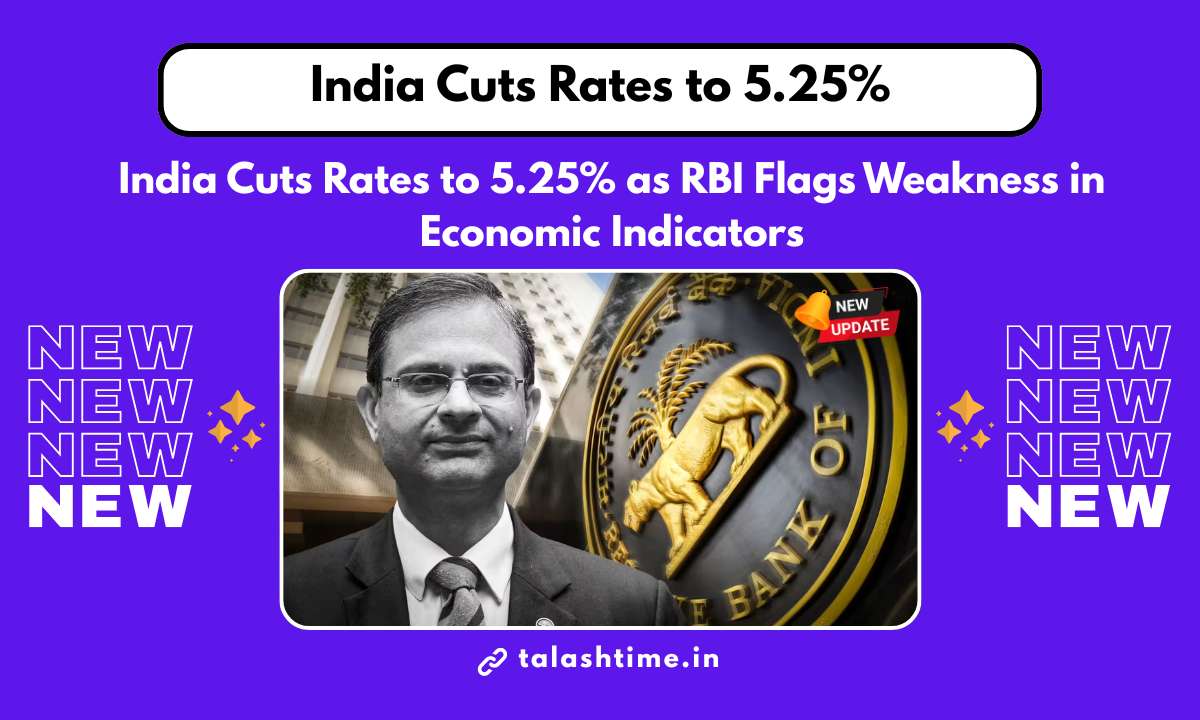
The Reserve Bank of India (RBI) has trimmed its key lending rate (repo rate) to 5.25 per cent — a widely anticipated move amid signs of economic “softness in some key indicators.” The decision aims to ease credit costs, support growth and provide relief to borrowers across India. This article explains what this rate cut means, why RBI acted now, and how it affects ordinary citizens, borrowers and the economy. This guide will help Indian readers understand this topic clearly.
Last Updated: 06 December 2025
Quick Highlights
- Topic Summary: RBI cuts repo rate by 25 bps to 5.25 % citing easing inflation and some weakening in economic indicators.
- Target Audience: Borrowers (home, auto, personal loans), savers, investors and general public in India.
- Key Benefits: Lower loan EMIs and borrowing costs, boost for housing & auto purchase demand, likely reduction in overall lending rates.
- Important Reminders: Banks may take time to pass on full rate cut; deposit rates & FD yields may also fall; long-term returns on savings could be lower.
What Is This News About?
The RBI’s Monetary Policy Committee (MPC) met in early December 2025 and unanimously voted to reduce the repo rate — the rate at which commercial banks borrow from the central bank — by 25 basis points (bps). As a result, the repo rate now stands at 5.25 per cent. :contentReference[oaicite:1]{index=1}
This is part of a broader monetary-easing cycle: in 2025, the RBI has cut rates by a total of 125 bps to support growth and stabilize liquidity. :contentReference[oaicite:2]{index=2}
Why Did RBI Cut the Rate?
- Benign Inflation: Inflation has eased significantly, giving RBI room to reduce rates without destabilising prices. :contentReference[oaicite:3]{index=3}
- Strong Economic Growth but Warning Signs: While the economy showed strong growth recently, RBI flagged “weakness in some key economic indicators,” suggesting caution. :contentReference[oaicite:4]{index=4}
- Need to Boost Credit & Liquidity: The rate cut is aimed at making loans cheaper and encouraging borrowing, spending and investment — potentially helping growth sectors, housing demand and consumer sentiment. :contentReference[oaicite:5]{index=5}
- “Goldilocks” Window: RBI described the current combination of moderate inflation and adequate growth as a “rare Goldilocks period,” suitable for easing. :contentReference[oaicite:6]{index=6}
What Does a Repo Rate Cut Mean for Borrowers & Savers?
Borrowers (Home, Car, Personal Loans)
- Floating-rate loans linked to external benchmark or repo will likely see lower interest rates — leading to reduced EMIs. :contentReference[oaicite:7]{index=7}
- New home or auto loan applicants may get access to cheaper credit — potentially improving affordability and pushing demand in housing and auto sectors. :contentReference[oaicite:8]{index=8}
- Overall interest burden on borrowers may ease — a helpful relief in times of inflation or rising living costs.
Savers and Fixed Deposit Investors
- Banks typically pass rate cuts onto deposit / fixed deposit (FD) rates — FD interest rates may fall further, reducing returns for savers. :contentReference[oaicite:9]{index=9}
- Investors whose income depends on fixed-income or savings instruments should re-evaluate new FD deposits or explore diversified investments (like equities or mutual funds) for better real returns.
Wider Economic Impact
- Credit Growth & Consumer Demand: Cheaper credit could boost demand for homes, vehicles, durable goods and business loans — supporting growth in consumption and investments. :contentReference[oaicite:10]{index=10}
- Real Estate & Auto Sector Boost: Lower EMIs and interest rates may revive demand in housing and auto sectors — sectors that are interest-rate sensitive. :contentReference[oaicite:11]{index=11}
- Inflation & Price Stability: With inflation already low, the cut is unlikely to spur sharp price rises — giving room for growth without inflationary pressure. :contentReference[oaicite:12]{index=12}
- Liquidity & Investment Flow: The RBI also announced liquidity-boosting measures (open market operations and forex-swap support), which may support bond and credit markets. :contentReference[oaicite:13]{index=13}
What to Watch Out For / Possible Downsides
- Not all banks may immediately pass the full rate cut to borrowers — transmission may take a few weeks to months.
- Fixed Income & FD investors may earn lower returns — affecting retirees or conservative savers.
- If growth and credit boom too fast, inflation could resurface — RBI may need to reverse course later.
- Borrowers should ensure they do not over-leverage just because loans are cheaper; loan decisions must be based on ability to repay.
What Should You Do as a Borrower / Saver?
- If you plan to buy a home or car soon — now may be a good time to explore loan offers, as EMIs may be lower.
- If you have an existing floating-rate loan — watch for reduced EMI or consider prepaying part of loan to save interest costs.
- For savers — consider diversifying into equities, SIPs or other investments if FDs are no longer attractive.
- Maintain a balanced portfolio: combine fixed income, equities and other assets — don’t rely only on fixed deposits.
- Budget carefully — cheaper loans may tempt some into taking bigger loans; avoid over-committing.
Conclusion
RBI’s decision to cut the repo rate to 5.25 per cent — in a context of low inflation and steady growth but warning signals from certain economic indicators — can provide a welcome boost for borrowers and help revive demand in key sectors like housing and auto. However, savers and conservative investors may see lower returns, and the full benefit will depend on how quickly banks pass on the rate cut. If you are considering a loan or have existing debt on floating rate, this is a good time to reassess your finances. For savers, it may be time to re-think fixed-income allocations and explore diversified investment options.
Note: All photos and videos used on this website are sourced from Google or YouTube. If you have any issue with any image or content, please mail us at support@talashtime.in.
If you want this post removed or modified, please contact us here: CONTACT US